Yuriko Tajima
The Final CurtainYuriko Tajima’s life is shaped by a painful divide between leaving her family and continuing to love them. After depression and guilt convinced her that she had failed as a wife and mother, she left her husband and young son, Kyoichiro Kaga, and began again in Sendai. She never returned, but Shunichi Watabe’s posthumous letter reveals that she kept thinking of her son, took joy in his achievements, and hoped his career would flourish. Her story reframes an apparent abandonment as a desperate act of self-protection, followed by years of private remorse and enduring attachment.
Identity and Early Life
Born Yuriko Tajima, she had lived in Tokyo before moving to Sendai. Her early adulthood included work at a Shinjuku club: after her father died in an accident, the jobs her sickly mother could find were insufficient to support the family, so Yuriko worked there until she married. Her mother died a few years later. Those losses and the responsibilities she carried became part of the history she would eventually understand through guilt rather than as circumstances beyond her control.
In Sendai, Yasuyo Miyamoto encountered a woman who answered questions without evasion but did not readily disclose her inner life. Yuriko spoke pleasantly and with education; Yasuyo found her intelligent and valued her direct eye contact. Her quiet reserve helped make her compelling to others, yet it also meant that even people close to her did not immediately know the full story of her family or her distress.
Leaving Her Family
Yuriko’s account of the separation was initially reduced to a devastating judgment on herself: she said she had failed as a wife and as a mother. She had a son, Kyoichiro, who was twelve when she left her husband. Yasuyo had not known Yuriko was a mother until that confession. Yuriko accepted responsibility for the marriage’s failure and did not suggest that her husband’s infidelity had driven her away.
The fuller explanation reaches Kyoichiro much later, through Watabe’s letter. More than a year after he met Yuriko, she told him about her family. She believed she had been a burden to her husband from the beginning of their marriage, felt guilty that her mother died despite the demands she had made on her husband to help care for her, and came to doubt her ability to raise a child. Watabe believed she had experienced clinical depression, though the condition was not understood by the people around her at the time. Yuriko instead interpreted her suffering as proof that she was a failure.
For years, she struggled with thoughts of suicide. Her son’s sleeping face could draw her back from that edge: she worried about who would care for him if she were gone. One night, after her husband had been away from home for several days, she found herself in the kitchen holding a carving knife. Kyoichiro had come out of bed and asked what she was doing. She put the knife away and soothed the situation, but afterward she feared that she might have intended more than to end her own life. That fear—that she could put her child in danger—helped make leaving seem safer than staying.
She boarded a train without knowing where she was going, carrying only a vague plan to die. Instead, she began a second life in Sendai. Watabe described her sense of that life as divided between remorse for abandoning her husband and son and gratitude to the people who helped her in an unfamiliar place. He suspected that leaving home eased her depression, but her account did not amount to a wish to erase her family. When he asked whether she wanted to return, she shook her head; he understood this not as lack of desire, but as a belief that she was unworthy of going back.
Life in Sendai and Relationship with Watabe
Yuriko worked at Seven for about ten years. She maintained a reserve that Yasuyo recognized as part of her appeal, but her reticence also concealed how much shame she carried. When Yasuyo asked about her divorce, Yuriko said it was her own fault, and the sternness that came over her as she judged herself made the confession feel less like an explanation than a sentence she had already passed on herself.
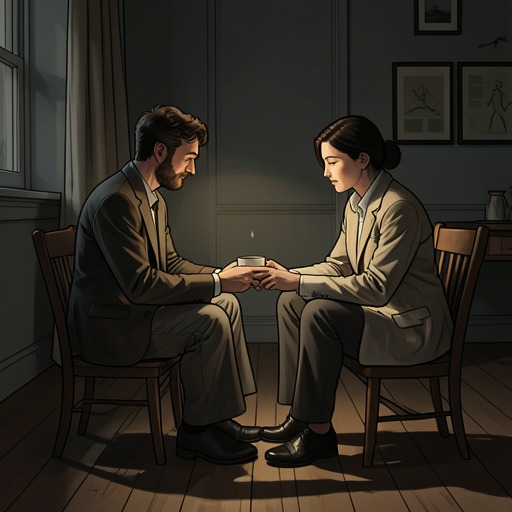
During her years at the bar, Yuriko developed a deep attachment to one of its regular patrons, Shunichi Watabe. He usually sat in a corner at the counter, drinking weak whiskey and water while reading a magazine or listening to the radio through earphones. He stayed until closing; Yuriko noticed his feelings for her and, over time, came to feel the same way. She referred to him formally as Mr. Watabe, and when Yasuyo asked about their relationship, Yuriko acknowledged it with slight embarrassment. Watabe became the person to whom she eventually entrusted the history of her family.
That trust made him a witness to the connection she kept hidden from almost everyone else. At her eventual prompting, he obtained Kyoichiro’s and her husband’s names and addresses, then visited the family home while in Tokyo. He did not mention Yuriko: he asked for directions and made discreet inquiries of a neighbor. He learned that her husband, Takamasa, was well, that Kyoichiro had moved out, and that the young man had won a kendo competition. At a bookstore Watabe found a kendo magazine featuring Kyoichiro and took it back to Sendai.
Yuriko studied the photographs of her son with tears in her eyes and told Watabe she was happy. The news that Kyoichiro had joined the police also relieved her: she had feared that her departure would turn son and father against each other, and she took his choice of the same profession as his father as evidence that this had not happened. She declined to keep the magazine, believing that a mother who had abandoned her responsibilities had no right to hold on to such a reminder, and that keeping it might somehow hold Kyoichiro back. Her refusal expressed the same contradiction that marked her life: she cherished his progress, yet felt compelled to deny herself a keepsake of it.
Death and the Delayed Account
Yuriko died in her apartment in Sendai while Watabe was away working at the Hamaoka Nuclear Power Station. Her death was treated as unnatural. Because Watabe feared that a police interview could expose him, he could not return to Sendai. Yasuyo, who had been Yuriko’s guarantor, took responsibility for the practical aftermath: after the cremation she brought Yuriko’s ashes home and faced the task of clearing the apartment. A modest funeral was held in the smallest room at a local funeral hall, with a few of the bar’s regulars present. Yasuyo repeatedly tried to reach Watabe and, hearing nothing, assumed he had disappeared rather than take on the trouble.
Watabe eventually contacted Yasuyo and supplied Kyoichiro’s name and occupation: he was a policeman working for the Tokyo Metropolitan Police. Through this information, Yuriko’s surname was clarified as her maiden name, resumed after her divorce; her son belonged to the Kaga family. Kyoichiro later came to Yasuyo’s home and offered incense and a prayer before the household altar. Yasuyo told him only that his mother had said she failed as a wife and mother. His dismay at the word showed how little he had known of the state in which she had left him.
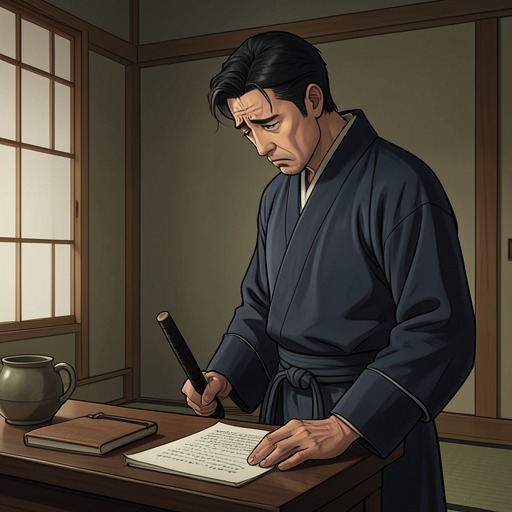
The explanation came in Watabe’s letter to Kyoichiro, conveyed through Hiromi Asai. Written near the end of Watabe’s life, it described Yuriko’s depression, her fear for her son, and the happiness she had felt on learning that he was safe and successful. Watabe admitted that his account could not remove the past or provide practical redress; he wrote because he did not want to leave the truth about the woman he had loved unspoken. The letter made visible the difference between Yuriko’s repeated claim that she had failed and the care that persisted beneath it.
Relationships and Significance
Yuriko’s relationship with Kyoichiro continued in the form of attention at a distance. She did not go back to him, and the evidence does not show that she directly explained her decision to her son while alive. Yet she asked Watabe for his family’s details, allowed him to make discreet inquiries, and took profound pleasure in learning that Kyoichiro had become a police officer. Her fear that he blamed his father reveals that she thought about the consequences of her departure for the family she had left behind, not only about her own survival.
Takamasa, in turn, understood the departure as bound up with Yuriko’s mental health. He believed that his failure to help her work through her difficulties made him responsible, and he did not pursue her. He thought she must have wanted to see her son before she died; the possibility caused him physical pain. His recognition came too late to restore the family, just as Kyoichiro’s understanding comes through other people’s memories and letters rather than through a conversation with his mother.
The repeated language of failure gives Yuriko’s story its central tension. The first account Kyoichiro hears is the one she used to condemn herself; Watabe’s testimony supplies the circumstances that the label concealed. Her departure harmed and bewildered the family, but it also arose from a fear that she might endanger the child she loved. The novel does not make those consequences disappear. Instead, the distance between her self-judgment and her continuing love becomes the means by which Kyoichiro can begin to understand his mother as more than the absence she left behind.